There is a sadness at the heart of America. It pervades everything we are, everything we do, everything we touch. Every fifty-five years [1] or so, we all take sides in an argument we have been having since our country was founded. Like an old married couple that seem to fight about many different things, but in reality the argument is always based on that same thing, that same issue, the issue of racial inequality.
It wasn’t supposed to be like this. Some of our ancestors came here from Asia many thousands of years ago as the last ice age retreated. Our continent was briefly visited by Scandinavians, Chinese[2], and finally permanently settled by groups of Spanish/Portuguese, French, German and English speaking peoples. Some came to live here, many came to make their fortunes and then move back home to Europe as wealthy people. America was founded on the get rich quick scheme. Eventually, people from every corner of our world came to the Americas to live permanently. Among them were people enslaved as property.
It wasn’t supposed to be like this. The more prosperous, more advantaged of us adopted this ideal of democracy from the ancient Greeks and Romans. Everyone who came to these shores through hard work, determination, and faith in their creator could be successful. Could share in the wealth of our country. Could share in the decision making process of politics. But ‘everyone’ was not every person here. Everyone did not include women. Everyone did not include people who did not own land. Everyone did not include the people already here. Everyone did not include those enslaved and owned by others. Some of us were more ‘equal’ than others[3].
It wasn’t supposed to be like this. After some period of assimilation, everyone who comes to our continent is supposed to share fully in the rights, responsibilities, and privileges of an American. But it ain’t necessarily so [4]. The people at the top of our American hierarchy, have decided they like being privileged. To the detriment of all of us, the caste system of ‘whiteness’ was adopted to separate who can enjoy all the benefits and privileges, and those who should know and keep to their place out of sight and out of mind. The non-white people who should be grateful for the scraps they receive, grudgingly paid from the enormous wealth that they create for their fellow Americans who just happen to be more equal than they.
Once again we celebrate another Juneteenth. During this most recent 55 year cycle of partisan strife between those who are white, ‘normal’, ‘American’ and those who are striving for equality, safety, and inclusion for everyone who is attempting to live in our America. If there is anything that can unite us all, it is that sadness which is the original sin of America: that for some of us to be so prosperous, many more of us have to be exploited. For some of us to be included, many more of us must be excluded.
For the upholders of the status quo – our uniquely American systemic, cultural, racial and class based caste system – who claim that eventually we will all share in the benefits of our society. That nagging feeling, that constant doubt, that fear of the other, that insecurity that all the hard won status of whiteness might be lost. For in America it is not what you are, who you know, or even what you have done that count – but what have you done for me lately – which maintains your status on the job, or in your community. This leads to that zealous rage against these people who protest, who remind us all of our troubled past and present. Who remind us of what we would leave safely buried. Underlying that rage and fear is that American sadness that things will never be as in that mythic past when everyone knew their proper place.
To those who celebrate this Juneteenth. For the protesters who feel they have nothing to lose and everything to gain. To those who know that in the long arc of history all people must eventually breath free. To those who ask the questions of all of us, “If not us, then who? If not now, then when?” We celebrate our past progress in the certain hope that someday all people will be free, welcomed, and included in our America. While at the same time, we feel that bittersweet American sadness that for all the progress we have made, we still have so very far to go.
[1] Every ~fifty-five years we experience racial based unrest in the United States – examples:
War of 1812 (British forces promised enslaved Americans freedom if they helped British forces)
American Civil War 1861-1865
Racial unrest during/after WWI 1910s-20s
Late 1960s-early 70s
Now
[2] Menzies, Gavin. 1421: The Year China Discovered America. New York, NY, USA, William Morrow Paperbacks, [2008. Print.
[3] Orwell, George. Animal Farm: A Fairy Story. New York, NY, USA : Signet Classics, [1996. Print.
[4] Ira Gershwin, DuBose Hayward. “It Ain’t Necessarily So” From the Album “Highlights from George Gershwin’s Porgy And Bess”, performed by John DeMain with the Houston Grand Opera, RCA Victor, May 12, 1997. Audio Recording.
Justice has always been in short supply in the United States. This has never been news to poor, native, or enslaved Americans. As imperfect as our courts have been until the last 25 years or so, we had experienced more fairness, protection of civil liberties, more of “We the People” actually recognized as persons under the law, and treated as such. It had seemed that the “great moral arc of the universe” while long actually does bend toward justice. Then, in the 90’s the conservatives of the Republican party decided it was time to turn back the clock, through ruthless partisan tactics to appoint radically conservative judges to the Federal courts.
The United States Federal courts are not supposed to be the forum where we as a society enact social policy. Our courts are supposed to rule on the cases before them, deciding on the merits of the law and the facts of the case, whether the litigants before them have been wronged and should be compensated or if the judgement against them was correct. The United States Supreme Court has for many decades, abandoned this role, instead seeking cases to rule on to establish precedent – the litigants seeking Justice before them be damned. Precedent is supposed to provide continuity to law in our United States. If a Federal court decides that the precedent to this point was wrong – that is a big deal – as in the decisions that “Separate is not Equal: in Education – which it plainly was not (and still is not), in many schools throughout our United States when predominately white schools have ample money, facilities and books, and schools which are in poorer white or brown communities make do with much, much less.
The six radically conservative Republican, and three liberal Democratic associates of our United States Supreme court are itself an artifact of a Republican Senator, the Honorable Addison Mitchell McConnell III, who in his position of Senate Majority leader blocked President Barack Obama’s supreme court nominee Merrick Garland from consideration in the Senate. Senator McConnell and the Republican majority prevented this position on the supereme court from being filled for 12 months, until after the election of President Donald Trump.
Republican Senator McConnell then displayed that perfect hypocrisy which demonstrates that no Republican can be trusted in the modern Republican party by reversing his rational for preventing consideration of President Obama’s supreme court nominee ( that there was an election coming up in 8 months ) to rush through confirmation hearings for Amy Coney Barrett, President Trumps third nominee to the supreme court, less than 2 months before the 2020 presidential election.
Through these Republican machinations, President Trump was able to seat 3, radically conservative Republican “Justices” to the Supreme Court of our United States. Supreme Court decisions were already getting decidedly more radically conservative. Some examples follow:
That women are not people after all – deserving of making their own decisions with their doctors about whether or not to carry pregnancies to term.12
That police officers need to be protected from anything more than cursory investigation, let alone prosecution from the deaths they cause in the line of duty. 34
That with mass casualty shootings almost every day, the second amendment has been construed to mean that any person in our United States has a personal right to carry a firearm in spite of the wording and meaning of the actual second amendment.5
That corporate persons rights are more important that the rights of the people that work for those corporations.6
Not only has the Supreme Court of our United States been corrupted by this sort of partisan ideology which supports moneyed interests over people, and gives no consideration of fact, or truth, or even basic common sense in favor of the strict legal arguments where both thumbs are firmly on the scales of Justice to construe the law to favor those self-same moneyed interests. An entire educational system of law schools, foundations, and professional societies have been established to advance the ideal of an absolute right of property to those few who hold the most wealth in our country. This idea originated in the early 19th century of the United States, when property included the enslaved persons who collectively represented 20% 78 of the wealth of our United States before the Civil War. The reforms of the 20th century: safe food and drug reforms of the Progressive era at the beginning of the century, the labor and finance New Deal reforms after the great Depression as well as the voting, civil rights, environmental and consumer protections of the 60’s through the 80’s, are all anathema to these self proclaimed “Public Choice”, “Economic Libertarians”. These proponents of extreme self-reliant, personal liberty believe that we all would be better off if workers were prevented from organizing and business’s are freed from financial and environmental regulation. Restricting government to providing domestic security ( basic policing ) and sovereign security ( military protection of the country ). Where the poorer among us – the Takers are denied any government services, while the wealthy Makers are not taxed of their well-earned wealth.
Who are these puppet masters who have through Republican Senator McConnell have put these radical conservative Jurists on most of the Federal Courts throughout our United States?
I recently read a book – Democracy in Chains, The Deep History of the Radical Right’s Stealth Plan for America, by Nancy MacLean. It was the reason this Part 3 took so much time for me to post. This book details the life and work of James McGill Buchanan and his influence on Charles and David Koch, using their resources to found the infrastructure necessary to destroy the liberal reforms accomplished by our United States in the 20th Century. To make our United States more like Chile under the dictator Augusto Pinochet Ugarte, and more importantly ( Buchanan was an advisor to Pinochet ) to create constitutional blocks to changing government policy, such that Chile even 30 years after Pinochet’s death still struggles with enacting more liberal policies.
This political and legal infrastructure which is attempting to impose this economic radical personel liberty on all of us, whether we like it or not; consists of the following institutions. Anyone who is half-aware of conservative policy will recognize some if not all of these institutions.
As these public choice policies have been implemented, the regular working public is increasingly having to shoulder more responsibility of our health care, our retirement, our consumer/worker health and safety. While the wealthy in our country pay less of a percentage of their income in taxes than the rest of us. Especially since most of their compensation is paid to them as stock rather than monetary wages. Public Choice personal “Liberty” can only be enjoyed by people with enormous wealth, who can buy for themselves all the protections, services, and security which we liberals believe should be enjoyed by everyone who lives and contributes to our country.
Paradoxically, this public choice, personal liberty movement seeks to increase the size and control of government over American society rather than as it purports, to shrink government control over our lives. The problem of public choice is that to provide the personal “liberty” for the wealthy among us, the rest of us must be prevented from electing public officials who will raise taxes on the wealthy to provide services to everyone.
The Republican party has been entirely captured by this point of view. Republican ideology is that government is the problem, so that the more incompetent, less effective Republican officials are: only better proves their thesis that government of the people does not work. Why should anyone vote for any Republican who promotes the tax cutting, government services cutting, anti-government ideology of our current Republican party? Why should anyone support a political party that instead of doing positive things for our country is only interested in obstruction?
Government is not our problem. Our problem is the Republican party and their ideological puppet masters, the architects of public choice, establishing the liberty of the wealthy on the backs of the rest of us.
“These are the times that try men’s souls. The summer soldier and the sunshine patriot will, in this crisis, shrink from the service of their country; but he that stands it now deserves the love and thanks of man and woman.” – Thomas Paine The American Crisis – 23 December 1776
We Americans once again are in political crisis. Unlike the revolutionary war period, today’s crisis is one of our own making. It is the result of both the political, legal decisions we made in governing ourselves and the decisions we did not make; where we allowed precedent and custom over time to harden into democratic norms of belief and behavior which are even more essential to our society than any written law. Centuries ago, our forbearers decided that we should have two political parties compete to package our choices in government. The parties have changed names and positions over time, but essentially one will represent a conservative position on governmental policy, while the other counters this position with more liberal ideas on governance. The parties themselves, recognizing that limiting the electorates choice to just these two alternatives enhanced their power, both adopted a “conservative” position in actively repressing the establishment of other political parties. The last time there was the establishment of a new major political party was over 160 years ago before our Civil war when the Republican party was formed to prevent the spread of slavery to new states in our United States.
Our two party system requires that both parties wholeheartedly conform to the discipline of the following societal democratic norms of belief and behavior to function properly.
Both parties must agree to work with each other, toward the common good of our country
Both parties must agree to abide by the results of elections
Both parties must agree that government at the Federal, State and Local levels all have a role in maintaining the common good for all of us
Our current crisis is that only one political party in our United States, currently conforms to the above democratic norms of behavior – the Democratic party. Many members of the Republican party have openly rejected these norms of belief and behavior of civil society. The Republican party for my entire lifetime ( I am 61 this year ) has been lowering it’s standards in all these areas, in favor of a policy of consolidating political power in any way possible. This consolidation of power and influence has been accomplished by their refusal to compromise, ignoring opportunities to enact policy for the good of all Americans, and a rejection in the idea that government itself ( except for police ) is necessary for any society. The Republican party has replaced the societal democratic norms in their party ideology with the ideal of absolute individual freedom, however it is a freedom that only those who agree with Republican ideas enjoy. Some examples.
Business free to pollute our common water and air, and pay lower ( or no ) taxes than the common individual taxpayer.
Every individual free to openly carry semi-automatic weapons in public while we experience mass shootings nearly every day somewhere in our United States.
Full personhood rights to a fetus while the woman pregnant with that fetus is denied the right of lifesaving healthcare to terminate that fetus even if it is not viable until she is on the verge of death herself.
All Republican party members, voters, and office holders own this madness in their sabotage of policy making and bear responsibility for the rejection of the normal democratic values and behavior which would lead to sound governance for our United States.
With the emergence of former President Donald Trump, this degeneration in the integrity of the membership of the Republican party has moved with stunning speed. I believe most Americans are overwhelmed by the new normal of naked corruption which has sullied many of our most cherished American institutions by the Republican party. The most notable victim of corruption being the Federal Judiciary, especially the majority Republican nominated members of the Supreme Court, where precedent has been replaced by partisanship, and constitutionality seems to be whatever policies this “conservative” majority wants to inflict on the rest of us.
It is my thesis in The American Crisis – 2024 that the United States cannot exist in any recognizable form with one of our major political parties intent on their own self-aggrandizement rather than the common good of our United States. The following postings will outline the damage that Republican party members and office holders have done to themselves and our United States. I will conclude these essays with a posting of the remedy to our Crisis. It will take us all, working together as Americans, to save our country. It is my hope that we can once again return our country to common norms of democratic governance.
“that this nation, under God, shall have a new birth of freedom, and that government of the people, by the people, for the people, shall not perish from the earth.”
– Abraham Lincoln Gettysburg Address – 19 November 1863
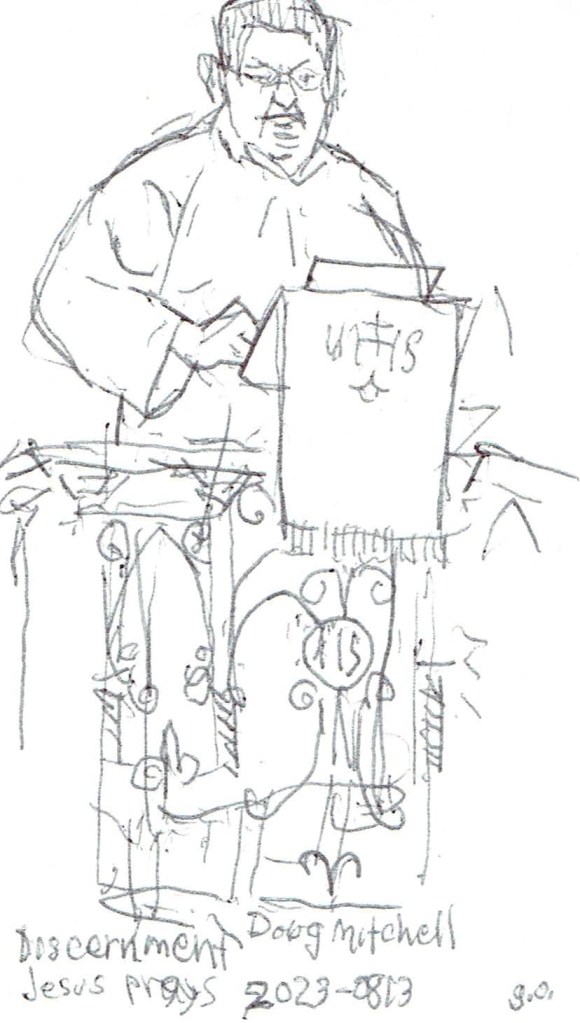
Several years ago, I was assigned to preach from these same lessons we have today, Proper 14 year A, in the season of Pentecost. I had just started preaching at Saint Martin’s in Des Plaines, IL. For several days, I studied these lessons and struggled about what I should preach. Then a realization came to me that at least two of the lessons were all about prayer and being in communion with the Holy Spirit. Our New Testament lessons, present to us, examples of prayer and discernment with the Spirit of God; from several different points of view.
The most obvious example of prayer and discernment is from our Gospel lesson from Matthew. A typical day in Jesus’ ministry on earth. After a long day of preaching and teaching, Jesus sends the people and his disciples away and secludes himself to pray. What could be a more typical passage in any of the Gospels? But notice how long Jesus is praying in this passage – He prays through most of the night into the early morning. My impression is that Jesus often prayed into the early hours of the morning. It was probably the only time of day when he could be alone, when it was quiet. In that time of profound silence and stillness when Nature herself seems to be holding her breath, (pause) that Jesus could pause to reflect and to allow His Father the time and space to speak to him.
Jesus Himself shows us how important it is to have this time for prayer and by His example.
It is in this profound silence, when we are calm, when we have emptied our minds of our concerns and our worries, when our thoughts are quiet; that we may be able to hear the Spirit of God speaking to us.
When I pray, I am reminded of the next passage in our gospel lesson.
We read that after Jesus had finished his prayer, he walks across the water through a violent storm to where the disciples were struggling to keep their ship afloat. The disciples see Jesus out in the storm, walking on the water – they hear him over the sound of the storm – and the disciples are terrified. They believe they are seeing and hearing some sort of ghost across the water. Peter asks Jesus to command him to walk across the water, and Jesus calls to Peter to join him.
This passage about Peter crossing the water feels like many of my experiences with prayer. How often have I started to pray, to attempt to reach across that gulf that separates us from God – only to start to sink, to be distracted by
the violent storm that sometimes is the world around me,
the violent storm that sometimes is my own thoughts and fears,
and finally, as I am going under, I call out to be saved:
O God, make speed to save me!
O Lord, make haste to help me!
Lord Jesus Christ, have mercy upon me! (pause)
For at least, 15 centuries, Christians have prayed these three, simple, prayers to our Lord: to be saved, to be helped, and for Jesus Christ to show us His mercy.
From all that I have read, and all I have experienced, I believe that people have always had these problems in prayer.
That is why we all must continually practice prayer, and through trial and error find out what works best for each one of us, at every stage of our lives; to help us in listening to the Holy Spirit.
In the discussion of prayer up to this point – we have concentrated on that journey of faith that we travel alone, in our personal relationship with the living God.
Paul, in our reading from Romans, takes this discussion to the next level.
But how are they to call on one in whom they have not believed?
And how are they to believe in one of whom they have never heard?
And how are they to hear without someone to proclaim him?
And how are they to proclaim him unless they are sent?
John Gill, the first Baptist theologian, in his commentary on Romans 10 verse 15 really helped me to understand the meaning of this passage.
Ordinary mission is of [people] to be pastors and teachers …. for whom Christ sends forth into such service, he bestows gifts on them, fitting them for it …. and it also includes a call unto it, which is …. by the Spirit of God ….. and the inclination of the heart to this good work which he forms; and which arises not from a vanity of mind, and a desire of popular applause, ….. but from a real concern for the good of souls, ….. being willing to deny themselves, and forsake all for Christ.
Paul’s four questions in our reading from Romans, are about how we are to call and select our ministers: our leaders and teachers in the community of Christ. Paul is laying the organizational groundwork for growing Christianity from a small group of believers to an organization – a Church. Paul is also describing the process of discernment; asking how we should listen; and to discern, to hear and to interpret, that whisper of the Holy Spirit, when we are being called to ministry into that larger Church organization.
Nine years ago, when I first preached on these lessons, I was two years into a discernment into ministry with the Episcopal Church in the Diocese of Chicago. I had met with my discernment committee at St. Martin’s in Des Plaines, IL over a period of six months. We had prayed together, and talked and listened together. My committee and I had discerned a call for me to continue to work towards ordination as a Deacon in the Episcopal Church.
As in our lesson from Genesis, with Joseph being sold into slavery by his own brothers, life seldom turns out the way we think it will. Joeseph had been the heir of his father’s fortune, the golden child, and not only that, but he was also having prophetic dreams in which his older brothers bowed down to him.
In my discernment for ministry in our church, life intervened in my plans in a much more gentle way than Joseph being sold to some passing Midianites. When I interviewed with the Diocese of Chicago committee on ministry about entering the Deacon training program, the committee did not hear my call to ministry. I was asked to come interview with them again – perhaps the following year. I had invested a great deal of my time and effort into entering the Deacon program in Chicago, and I was deeply disappointed. As I considered what I should do next, I answered another call for service, my father was losing his short-term memory and my mother needed help to take care of him. Darlene and I moved down here from Chicago to be near my parents as they made the transition from living in their own home to an independent living community in Marietta, Ohio.
I still have a great deal to learn about discernment.
What I have learned is that being in discernment is not an easy way to live, but it can be a very rewarding way to live.
Discernment guides us in choosing between the many paths we may follow, the many things we may do.
Usually, all the paths we are considering are good, productive, things that we can do with our time and our talents. But finding that one thing, that will really make a difference, can be difficult.
Discernment does not end after you are called into a ministry. Discernment continues.
My discernment continued even though I did not become a deacon in the Diocese of Chicago.
As I have come to understand what discernment is about, I was surprised by how familiar it turned out to be. It seems I have been in discernment all along, I was just not aware of what I was doing, as I used it in my daily life and work. All this time, in my work when I have been stuck on some technical problem. I clear my mind, and simply listen. (pause)
Given some time, from out of nowhere, I will receive an idea about how to approach that particular problem, or how to put together a solution. The artist waiting for inspiration, or the engineer awaiting that technical insight are in discernment. We are all opening ourselves; allowing our own divine nature to commune with the divine nature which is present in everything in the universe around us.
When we are inspired, we manage; for just that brief instant to hear God’s voice, the Spirit of God, speaking to us.
I have found that in discerning what God wants me to do – I am discovering what I am capable of becoming:
I am continually learning who I am.
God, as our Father and Creator, knows us far better that we know ourselves.
It is a startling, humbling and liberating experience to be middle aged and to be continually learning who I am, and what I am capable of becoming.
I’d like to leave you with this thought.
Discernment is for Everyone.
Not just those people, who are the clergy.
Not just those people who are on the vestry.
Not just those people, who are being called to ministry.
Everyone.
We should all be practicing how to be (pause) present and aware of the Holy Spirit speaking to us in our reflections, our thoughts, our feelings, and our prayers.
We should all be finding time, each day, to listen in profound silence, allowing the Spirit of God the time and space in our lives, so that we may hear (pause) the quiet voice of God.
Genesis 37:1-4, 12-28 Jacob settled in the land where his father had lived as an alien, the land of Canaan. This is the story of the family of Jacob.
Joseph, being seventeen years old, was shepherding the flock with his brothers; he was a helper to the sons of Bilhah and Zilpah, his father’s wives; and Joseph brought a bad report of them to their father. Now Israel loved Joseph more than any other of his children, because he was the son of his old age; and he had made him a long robe with sleeves. But when his brothers saw that their father loved him more than all his brothers, they hated him, and could not speak peaceably to him.
Now his brothers went to pasture their father’s flock near Shechem. And Israel said to Joseph, “Are not your brothers pasturing the flock at Shechem? Come, I will send you to them.” He answered, “Here I am.” So he said to him, “Go now, see if it is well with your brothers and with the flock; and bring word back to me.” So he sent him from the valley of Hebron.
He came to Shechem, and a man found him wandering in the fields; the man asked him, “What are you seeking?” “I am seeking my brothers,” he said; “tell me, please, where they are pasturing the flock.” The man said, “They have gone away, for I heard them say, ‘Let us go to Dothan.’” So Joseph went after his brothers, and found them at Dothan. They saw him from a distance, and before he came near to them, they conspired to kill him. They said to one another, “Here comes this dreamer. Come now, let us kill him and throw him into one of the pits; then we shall say that a wild animal has devoured him, and we shall see what will become of his dreams.” But when Reuben heard it, he delivered him out of their hands, saying, “Let us not take his life.” Reuben said to them, “Shed no blood; throw him into this pit here in the wilderness, but lay no hand on him” —that he might rescue him out of their hand and restore him to his father. So when Joseph came to his brothers, they stripped him of his robe, the long robe with sleeves that he wore; and they took him and threw him into a pit. The pit was empty; there was no water in it.
Then they sat down to eat; and looking up they saw a caravan of Ishmaelites coming from Gilead, with their camels carrying gum, balm, and resin, on their way to carry it down to Egypt. Then Judah said to his brothers, “What profit is it if we kill our brother and conceal his blood? Come, let us sell him to the Ishmaelites, and not lay our hands on him, for he is our brother, our own flesh.” And his brothers agreed. When some Midianite traders passed by, they drew Joseph up, lifting him out of the pit, and sold him to the Ishmaelites for twenty pieces of silver. And they took Joseph to Egypt.
Romans 10:5-15 Moses writes concerning the righteousness that comes from the law, that “the person who does these things will live by them.” But the righteousness that comes from faith says, “Do not say in your heart, ‘Who will ascend into heaven?’” (that is, to bring Christ down) “or ‘Who will descend into the abyss?’” (that is, to bring Christ up from the dead). But what does it say?
“The word is near you, on your lips and in your heart”
(that is, the word of faith that we proclaim); because if you confess with your lips that Jesus is Lord and believe in your heart that God raised him from the dead, you will be saved. For one believes with the heart and so is justified, and one confesses with the mouth and so is saved. The scripture says, “No one who believes in him will be put to shame.” For there is no distinction between Jew and Greek; the same Lord is Lord of all and is generous to all who call on him. For, “Everyone who calls on the name of the Lord shall be saved.”
But how are they to call on one in whom they have not believed? And how are they to believe in one of whom they have never heard? And how are they to hear without someone to proclaim him? And how are they to proclaim him unless they are sent? As it is written, “How beautiful are the feet of those who bring good news!”
Matthew 14:22-33 Jesus made the disciples get into the boat and go on ahead to the other side, while he dismissed the crowds. And after he had dismissed the crowds, he went up the mountain by himself to pray. When evening came, he was there alone, but by this time the boat, battered by the waves, was far from the land, for the wind was against them. And early in the morning he came walking toward them on the sea. But when the disciples saw him walking on the sea, they were terrified, saying, “It is a ghost!” And they cried out in fear. But immediately Jesus spoke to them and said, “Take heart, it is I; do not be afraid.”
Peter answered him, “Lord, if it is you, command me to come to you on the water.” He said, “Come.” So Peter got out of the boat, started walking on the water, and came toward Jesus. But when he noticed the strong wind, he became frightened, and beginning to sink, he cried out, “Lord, save me!” Jesus immediately reached out his hand and caught him, saying to him, “You of little faith, why did you doubt?” When they got into the boat, the wind ceased. And those in the boat worshiped him, saying, “Truly you are the Son of God.”
* The Axanar Combat Patrol and Klingon Hymn are essentially the same video with different soundtracks.
** Gathering Storm is a trailer, you will notice quick cuts from the other videos.
+ Star Trek Axanar opening scene is a great battle sequence – even in a not quite completely rendered state – it is the best Star Trek ship battle sequence I’ve ever seen.
A Personal Reflection on the Axanar Story Arc and Plot
I really like Axanar. I have followed it since the Prelude video was released 9 years ago. However, since that first Prelude video I have been troubled by one plot element that just does not ring true to my sense of the Klingon heart.
The basic concept behind Axanar – a history of the four year war with the Klingons, is that the Klingons did not view Star Fleet or the Federation as much of an enemy. There was little honor in slaughtering Federation ships and crews and so the Klingon fleet allowed some ships to get away; they did not press their advantage. The Klingons were content to secure the systems around the empire for future expansion and did not advance on into human space.
This allowed the Federation to pool the military technologies of all their member races: warp technology from the Vulcans, phasor technology from Andoria, and trained crews from all the Federation planets. The tide of the war turned. The Klingon Imperial navy was routed back to Klingon space with the new Ares class ships, and trained crews who had survived earlier encouters with the Klingons.
The Problem with Kharn
Kharn the Undying (in Prelude to Axanar ) gives this strange speech. OK, if the High Council had supported him he would have had the advanced ships he needed. Although, he squandered his advantage at the start of the war and he alone is to blame for that. Then Kharn talks about how frustrating it is to fight Star Fleet because the ships of the Federation are all crewed from different worlds, using differing tactics. This is totally out of character for a Klingon warrior. Any warrior is measured by the strength of his opponent. It is not in victory that a warrior is measured but in defeat. Fighting someone who is totally out of your class, against whom you have no chance of winning is the true test of the warrior. Death in battle against overwhelming odds is the ambition of every Klingon.
The Bridge Crew of the Ares
I served in the United States Navy. Although, I never served on the bridge of any ship, I maintained the electonic systems on the E2-C Hawkeye Aircraft (Carrier Air Early Warning – VAW 117). So the bridge scene during Interlude is not true to life in any military organization I’ve experienced. When an officer tells you to do something, you don’t make excuses. It does not matter how fast the Klingon ships are, commenting on it is not going to help you react any faster. Asking your captain to “give you a minute” just does not happen. It is a sad fact that so few actors have any military experience these days that these sorts of mistakes are pretty common. [In my opinion]The best war movies were the ones made right after WWII when so many men and women, including actors, had served in our military.
Getting off my soapbox, except for these small issues on my part – I love these Axanar videos. Axanar has captured the essence of what Star Trek was in the original series. That retro look of the uniforms. The sounds of the original star trek. And the ship designs, the Paramount designers are too into the Next Generation look of things, too sleek and streamlined. The Axanar team has truely captured what a precurser to Star Trek the original series would look like.
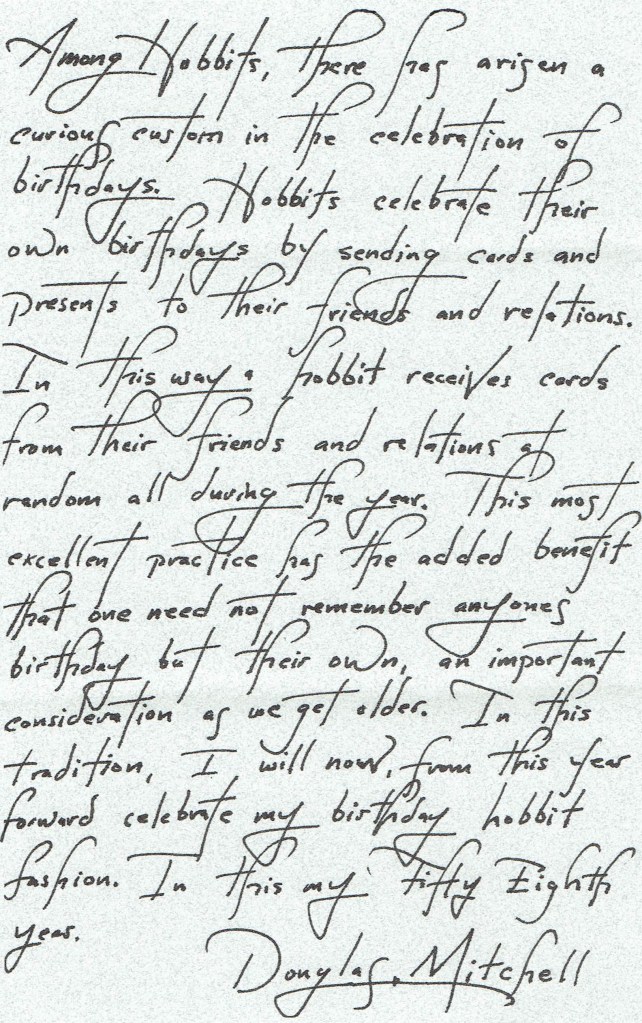
Among Hobbits, there has arisen a curious custom in the celebration of birthdays. Hobbits celebrate their own birthdays by sending cards and presents to their friends and relations. In this way a hobbit receives cards from their friends and relations at random all during the year. This most excellent practice has the added benefit that one need not remember anyones birthday but their own, an important consideration as we get older. In this tradition, I will now, from this year forward celebrate my birthday hobbit fashion. In this my Fifty Eighth year.
According to the scriptures, we are created in the image of God the Father, the Creator of the heavens and the earth.
I believe that the dreamers, makers and shapers most fully embrace this image of our Creator. We worship through our own acts of creation, with all the strength of our minds, our hearts, and our hands.
My father John William Mitchell was such a man. He loved repairing heavy equipment long abandoned by others. He delighted in using the backhoes, bulldozers and cranes which he had repaired and restored; like a small child playing with these machines in a sandbox. He and my mother Carol shared the dream of many homes, from the sweat of their brows and the work of their hands, they realized those dreams so that we could all enjoy and be sheltered by them.
My father was a man whose personal philosophy was physically demonstrated in wood, in steel and wire, electrical power and hydraulic movement, in homes which were comfortable in the cold of winter and the heat of summer. Like the true Buddhist, he did not covet the works of his hands, once he had repaired and used something he sold it to others, to fund the purchase of the next toy, or that next project. He only kept for himself the dream realized and the knowledge and skills he gained, which he then applied to the realization of that next dream.
Our father, mine and Susan’s, was first and foremost in everything he did; completely and authentically himself. As in the way of the Dao, he was like water, naturally taking on the shape of the situations in which he found himself, and also like water changing everything and everyone around him as a river moves sand from one bank to another. He raised us to always be who we are, to be true to ourselves. It did not matter to him who we decided to be, or how we lived our lives; but he always encouraged us to be wholehearted in whatever we do. If there was ever something we heard repeatedly from him as we were growing up, it was to never do anything half-assed.
In these last few years, my father showed us how to live day by day. With a grace that I have no words to express, he accepted the limitations of his mind and body.
I am grateful for every moment I shared in his presence.
He lives still in my heart and mind, and I will honor him with the work of my hands as long as I live.
Presentation to the Columbus chapter of the League of Professional Systems Administrators (LOPSA) on August 27th 2020.
In the early 70s, Robert Maynard Pirsig submitted a manuscript to over a hundred publishers. His manuscript, Zen and the Art of Motorcycle Maintenance: An Inquiry Into Values, was finally published in 1974 by William Morrow, earning him $3000. Pirsig was told by his publisher that they would be lucky to sell the initial run of just a few thousand copies. Within the first year of publication, Zen had sold over a million copies, his book was a best-seller for a decade, and has sold many millions of copies since. Zen and the Art of Motorcycle Maintenance has become a classic text, especially among those college students studying philosophy for the first time, as it takes western philosophy and tests its basic assumptions – contrasting the classical western European view of metaphysics against the assumptions and philosophies of Southern and Eastern Asia.
Pirsig has been quoted as saying that despite its title, “Zen and the Art of Motorcycle Maintenance” should “in no way be associated with that great body of factual information relating to orthodox Zen Buddhist practice.”, he has also said, “It’s not very factual on motorcycles either.”
What Robert Pirsig accomplished in his “Zen and the Art of Motorcycle Maintenance”, was to create a metaphysical, even scientific, explanation of why people engage in religious/philosophical ritual and practice. For thousands of years groups of human beings have created and practiced all sorts of rituals from the Norse Blot Sacrifice of mead and grain, to the Catholic Mass – body and blood of Christ, to American Indian sweat lodge and pain rituals, the prayers of Brahmans over their sacred fires in India, or the contemplation of our ancestors and many, many others that we will never know. Why? Why do we do these things? Because these rites, rituals, and practices work. These activities are useful to us – we are not machines – we are men and women and we need to believe in something to live and work together. These beliefs and practices are the basic operating systems of our minds. Our rituals help us to remember who we are, that we are not alone, and connect us to our community.
Like Zen and the Art of Motorcycle Maintenance, my talk today, Zen and the Art of Systems Administration is not the definitive work about Buddhist Zen philosophy, it is not going to be the end all, go to work about DevOps or UNIX administrative and engineering principles. What I am going to attempt to convey are a few things I have learned in maintaining and deploying networked UNIX systems during my career in the context of the essential core beliefs of Zen Buddhism. I believe that by following in the footsteps of the Buddha we can become better people, and more productive systems administrators. People who are making a meaningful contribution to our organizations in the good work of administering networked computing environments.
My name is Doug Mitchell, and I am currently calling myself a Linux Systems Engineer.
I have been designing, deploying, and maintaining networked UNIX systems for longer than I want to admit. I have established a limited-liability company Auspicious Clouds Computing, but am currently with Alliance Data in Columbus. For more about my particular career, you may go to the web site at
auspiciousclouds.us.
I am also a lay chaplain, having completed a course of study at Bishop Anderson House at the University of Chicago and my practicum at Alexian Brothers Hospital in Elk Grove, IL.
I give sermons at my local Episcopal church from time to time, I write poetry, fiction, and send letters to people in positions of authority – reminding them of our common humanity.
Many of these writings are posted online on the web site whatisgood.us
It would be remiss of me to give a talk about Zen Buddhism without talking about the life of Lord Siddhartha, the founder of Buddhism. One of the legends about his birth and childhood is that his father raised the young Siddhartha such that he never saw anyone sick, or injured, or suffering in any way. When Siddhartha was a young man, he was shocked to see the old, the infirm, the sick in his city. He sought out spiritual teachers who could explain to him why mankind seemed to be doomed to suffer, and after many years of spiritual discipleship in several different ascetic traditions finally decided to meditate under a bodhi tree for inspiration. For seven days and nights he mediated and when he rose from the bodhi tree he had achieved a mental and spiritual awakening – the title ‘Buddha’ means ‘Awakened One’.
Siddhartha, the Buddha now had a new enlightened understanding of the nature of the mankind’s relationship with the universe.
Siddhartha then traveled in search of his fellow spiritual students, and these fellow travelers became his first disciples, in time, spreading Buddhism to every corner of our world.
According to Buddhism, all suffering is because of our desires. Our desires and attachments to things, ideas, and people and also our aversions or fears – which are our negative desires; our fears of losing what we have, our fears of losing our loved ones.
All we have to do to escape the suffering of the world is to give up our desires and attachments. Once we are released from the chains of our desires and the need for attachments to things and other people – we are truly free to be ourselves. We will see the world clearly, without the distortions of our desires. We will stop projecting how we want things to be on our view of the world – we will be able to evaluate the evidence of our senses objectively and accurately.
Getting rid of our desires and attachments is not so easy, it completely goes against how most of us conduct our lives, accumulating stuff until the day we die. Buddhism is a practical philosophy, providing a path to this redemption – the eight-fold path – eight principles to help any of us to attain enlightenment – so that we too may be like the Lord Buddha – truly awakened to the nature of reality.
Getting back to Systems Administration….
Here we see an example of the source of our pain and suffering as systems administrators – from the point of view of Buddhist philosophy. This is a very simple example of perception verses reality, from the point of view of the Business, the Systems Admins, and the actual reality of a deployed system. We all simplify, make assumptions, use mental shortcuts in interpreting the world around us. To the Business, this system is a very small, minor application. They are barely aware of it at all, they know nothing about how it works, what depends on it. Perhaps it has never failed so it has never really has been brought to their attention.
To the Systems Admins it has a specific shape, it is more important, they are aware of the dependencies on it, how it is installed, how to restart it. But this system is a ‘black box’ in that they have no visibility inside of it – about how it actually performs its function.
The reality is that there are all sorts of internal structure to this system. But no one in my example is aware of this.
Let’s say that the systems team makes some predictions about porting this system to another type of operating system, or that it will work with a different version of Java, or different kernel libraries. And they are wrong – they made these predictions without the knowledge of the reality of this system. They perform a deployment, which crashes and burns because this vital system no longer works in the way it did before.
How can we avoid situations like this?
How can the Eight-fold path help us to see our systems clearly?
These initial Buddhist practices come directly from the fault and root cause analysis of our simple perception verses reality example. To make wise decisions, we must be aware of what is right in front of us. We must have a true understanding of how our systems work, what the dependencies are, and only then can we reliably maintain them.
We must continually, test our assumptions in the course of our daily work. After many years of logging into UNIX systems – I am very aware of how long commands take to complete, the general performance of a system simply from the command response.
I have often ‘discovered’ error states on systems while performing maintenance on something completely unrelated. For example, just a couple of months ago I was performing a refactoring of my Ansible scripting – completely changing how I support virtual server inventories. After the refactor, I did some testing against groups of servers with the Ansible ping command. A production server did not respond to the ping – so I checked it out. It turned out that the server was non-responsive, and our monitoring tools did not pick up on it because it was still executing, still seemed to be booted, but it could not respond to the Ansible ping. It was part of a cluster of database servers – so nothing was off-line, but I had discovered a new failure state – from testing some scripting changes.
We should always be mindful, and present even when doing the most routine of maintenance; having a mind open to the possibility of learning something new.
Our words and our actions, define who we are. Have you ever been in a situation which you made infinitely worse – by something you said. (pause) I have. (pause) Wisdom has more to do with what we do not say. If you are in doubt about making a comment – just keep it to yourself. This is not to say that we should not speak the truth – if the situation demands it. It may cost us our job – but if you are ‘in trouble’ for telling the truth to your management – you really need to be looking for another position.
Systems Administrators by the virtual of the access we have to the computing environments we maintain have to exercise a great deal of caution in the commands we enter, the widgets we click on, the systems we decide to access. In the course of my career I have rebooted the wrong servers, deployed the wrong software to whole groups of servers, run scripts and programs that have brought UNIX systems to their knees. Most of the time if we are mindful, and present we can recover from these mistakes.
Many years ago, I was supporting Solaris servers which were part of a tape backup solution. The company was a subcontractor for AT&T performing tape backups at all their data centers. The home office was in North Carolina. One day the central office sent us a data collection script, we were to execute on our servers. A data file was to be created which we were to email back to the home office. I took a quick look at the script, it did not seem to be too invasive. I started it. The server immediately was loaded down, command response on other terminal sessions was poor, the disk activity light was going crazy. I hit Cnt-C to kill the process. The script had a recursive loop error in it that I had missed, which would keep writing the same data to an output file over and over again. Eventually filling the root file-system of the system it was running on as the output file was hard-coded to write to /. I quickly contacted by brother and sister admins across the company at our other sites – but we had service outages in about 40% of our data centers while recovering from this self-induced issue.
Being aware, and present to the here and now – saved me from some extra work that day.
I’ve mentioned mindfulness and being present several times in this talk already and there it is on this slide as a spiritual discipline for a Buddhist.
A more disciplined approach to our deployments can help us complete them a great deal more easily. Often times we are unaware of systems dependencies until that one system that is usually so reliable goes down.
Another example of this is how Databases are accessed by applications. I once made a functional systems diagram of an e-commerce site showing all the web application interactions with our database servers. It looked like a spider web, because every server in the deployment had to access the database in putting items in the shopping cart, placing the order, or order fulfillment. The e-commerce application had been written by several developers over several years and when they needed data from the database, they just issued a call for it. As functions were distributed to different servers, the scripting moved to a new server and now that server also needed direct access the database as well. Every server now needed to access the Database server for the implementation to work. I was tasked with implementing better network security – but with this e-commerce system – any network security measures broke some part of the ordering process.
Applications do not have to be implemented this way.
I worked for a startup in Chicago which created and operated an online Commodities trading platform. We completely reworked our systems architecture, clustering solution and software applications three times in four years, while supporting active users for 3 of those years. It was a very small team – 5 developers including myself. After all those implementations, we settled on an architecture that separated the Client facing RESTful API layer from our market data layer, and order processing layer. Our final version was a marvel – the best work I’ve ever done. The final systems executing in AWS were completely modular. All the EC2 Ubuntu instances were interchangeable with each other – depending only on parameters set in a GitHub release which differentiated each server from each other. I did no patching, replacing these generic virtual servers every 2-3 months. Every boot of every virtual server redeployed both configuration and application version.
One of the habits I developed in that Chicago position was my morning commute by train into the city. I started reading from the Christian book of Psalms on my morning and evening commutes. In reading and meditating on these psalms (which means songs), I was unintentionally entering a meditative state, encouraged a presence of mind, a centering of the soul, which carried though into my work day. One of the great misunderstandings of our modern age is that we have forgotten how the state of our minds affect our health, our work, the relationship between our mind and body and our interactions with other people.
We would never operate our cars or our motorcycles without regular oil changes, or tuneups, yet we do no regular maintenance on the most important thing we have, the essence of who and what we are, our minds.
Regular meditation, intentional introspection and commitment to this type of a disciplined routine mental exercise is essential in the proper functioning of our minds just as regular physical exercise is essential to the body. It might also help us in the performance of our best work.
This talk has turned out to be very different than the one I had imagined. I was going to base it more on Robert Pirsig’s book Zen and the Art of Motorcycle maintenance. But I am not the same person I was when I first read Pirsig’s book in the early ’80s. I have changed. Since then, I have found a spiritual home in the Christian traditions of both the Episcopal Church and the Society of Friends – the Quakers. Pirig’s whole thesis of proving that a mental, spiritual discipline is necessary for us to be our best selves is second nature to me now.
What I have discovered in the formulation of my very brief introduction to Buddhist belief and practice here is how this type of discipline has helped me in my work. I never really put it together before – that the one time in my life I following a regular practice, just because I was commuting by train to downtown Chicago – I also performed my best work as a systems administrator. I had always thought that it was the particularly smart people I worked with. I have thought that the startup nature of the company might have been the reason. I think these contributed to a positive work environment. But I cannot now discount that I was also a little different, perhaps more ‘centered’ than I had been before. Perhaps I was more ‘mindful’, and ‘present’.
It seems I need to get out my psalter and start a regular practice of again reading from the Psalms every day, (pause) or perhaps, (pause) from the sutras of the Buddha.