On November 12th, 2019 – I posted the letter that I physically sent to all 435 members of the United States House of Representatives. In that letter, I urged the members of Congress to include President Trump’s violation of the constitution under both emoluments clauses in the artlcles of impeachment. ( First Impeachment )
This month on January the 4th, the Democratic party members of the Congressional Committee on Oversight and Accountability released the report – White House for Sale: How Princes, Prime Ministers, and Premiers Paid Off President Trump. Although the Republican representatives did their best to derail this investigation, this report documents the at least 7.8 million dollars that President Trump received while in the office of President of the United States. According to the Consititution of our United States – all that has to be proven in violating the emoluments clauses is the receipt of monies from organizations, public or private, foreign or domestic.
My letter to the members of the United States House of Representative in November 2019 follows.
Honorable Ladies and Gentlemen,
I have been following closely your progress in investigating and drafting articles of impeachment for President Donald John Trump with considerable frustration. From his first months in office, President Trump has accepted payments (emoluments) to his businesses (from which he has divested in name only) from domestic and foreign organizations and governments in direct contravention to the United States Constitution Article 1, Section 9, Paragraph 8:
No Title of Nobility shall be granted by the United States: And no Person holding any Office of Profit or Trust under them, shall, without the Consent of the Congress, accept of any present, Emolument, Office, or Title, of any kind whatever, from any King, Prince, or foreign State.
and Article 2, Section 1, Paragraph 7:
The President shall, at stated Times, receive for his Services, a Compensation, which shall neither be encreased nor diminished during the Period for which he shall have been elected, and he shall not receive within that Period any other Emolument from the United States, or any of them.
The meaning of these clauses that no federally elected official is to receive any gift, payment, or payment in kind; is so clear that no president before now has even sought to challenge them.
A further charge of obstruction of justice suggests itself from President Trump’s repeated successful attempts thus far to block the release of his tax returns. The lengths of litigation to which President Trump is willing to commit would make any reasonable person wonder at the perversities he has indulged in his tax filings.
Please include in your articles of impeachment the charges of receiving emoluments from organizations and governments both foreign and domestic. We need to set a strong precedent that our federal officials cannot accept payments of any kind from any source.
6 And you will hear of wars and rumors of wars; see that you are not alarmed; for this must take place, but the end is not yet. 7 For nation will rise against nation, and kingdom against kingdom, and there will be famines and earthquakes in various places: 8 all this is but the beginning of the birth-pangs.
According to Wisevoter.com there are currently 32 countries presently at war, most of them at war with themselves in civil: terrorist, political, and drug wars and this does not include the recent conflict in Israel. The passage in Matthew is most commonly thought of as a prophesy of an apocolyptic end time, but my feeling is more of disappointment in ourselves as people. We are all forgetting the progress we have made together. We are drifting backwards into scarcity patterns of thought, when we are ready to do violence to all people we identify as ‘them’ to protect the people we identify with as ‘us’.
The conflict in Israel (Gaza) is particularly damning, and unique in war as the general population has been oppressed by both an occupying power and their own political leadership for decades. Now this low level conflict has escalated, and there is nowhere to go. In all other conflicts, there has been somewhere to flee, to escape, but not in this war.
For several years, I have advocated among my small circle of friends, that the United States should allow anyone in territories controlled by the state of Israel asylum with a roadmap to full naturalized citizenship in the United States. This offer of asylum should be understood as part of the security guarantees made to support the State of Israel.
Everyone living in Israel is a veteran. The members of the military organizations on all sides. The civilian populations in all the countries of the region. I wish that all veterans could put down our weapons, so that we all may use our brief time on this good earth to work with and support each other.
One hundred and five years ago on September the 12th 1918, Eugene V Debs was convicted under the Sedition Act of 1918 for a speech he gave in Canton, OH on June 16th, 1918. Eugene Debs was aware of the recently passed (May 16th, 1918) Sedition Act, and carefully crafted his remarks such that he did not use “disloyal, profane, scurrilous, or abusive language” about the United States government, its flag, or its armed forces or that would caused others to view the American government or its institutions with contempt. ( From the Sedition Act of 1918 )
In Federal Court in Cleveland, OH, the jury found Eugene Debs guilty on 3 counts: attempting to incite insubordination, disloyalty, mutiny, and refusal of duty in the armed forces of the U.S.; obstructing and attempting to obstruct the recruiting and enlistment service; and uttering language to incite, provoke, and encourage resistance to the United States. Judge Westenhaver sentenced Debs to 10 years imprisonment pending an appeal to the Supreme Court, which upheld Debs’ conviction.
At his sentence hearing Eugene Debs made this statement to the court.
Your Honor, years ago I recognized my kinship with all living beings, and I made up my mind that I was not one bit better than the meanest on earth. I said then, and I say now, that while there is a lower class, I am in it, and while there is a criminal element I am of it, and while there is a soul in prison, I am not free.
I listened to all that was said in this court in support and justification of this prosecution, but my mind remains unchanged. I look upon the Espionage Law as a despotic enactment in flagrant conflict with democratic principles and with the spirit of free institutions…
Your Honor, I have stated in this court that I am opposed to the social system in which we live; that I believe in a fundamental change—but if possible by peaceable and orderly means…
Standing here this morning, I recall my boyhood. At fourteen I went to work in a railroad shop; at sixteen I was firing a freight engine on a railroad. I remember all the hardships and privations of that earlier day, and from that time until now my heart has been with the working class. I could have been in Congress long ago. I have preferred to go to prison…
I am thinking this morning of the men in the mills and the factories; of the men in the mines and on the railroads. I am thinking of the women who for a paltry wage are compelled to work out their barren lives; of the little children who in this system are robbed of their childhood and in their tender years are seized in the remorseless grasp of Mammon and forced into the industrial dungeons, there to feed the monster machines while they themselves are being starved and stunted, body and soul. I see them dwarfed and diseased and their little lives broken and blasted because in this high noon of Christian civilization money is still so much more important than the flesh and blood of childhood. In very truth gold is god today and rules with pitiless sway in the affairs of men.
In this country—the most favored beneath the bending skies—we have vast areas of the richest and most fertile soil, material resources in inexhaustible abundance, the most marvelous productive machinery on earth, and millions of eager workers ready to apply their labor to that machinery to produce in abundance for every man, woman, and child—and if there are still vast numbers of our people who are the victims of poverty and whose lives are an unceasing struggle all the way from youth to old age, until at last death comes to their rescue and lulls these hapless victims to dreamless sleep, it is not the fault of the Almighty: it cannot be charged to nature, but it is due entirely to the outgrown social system in which we live that ought to be abolished not only in the interest of the toiling masses but in the higher interest of all humanity…
I believe, Your Honor, in common with all Socialists, that this nation ought to own and control its own industries. I believe, as all Socialists do, that all things that are jointly needed and used ought to be jointly owned—that industry, the basis of our social life, instead of being the private property of a few and operated for their enrichment, ought to be the common property of all, democratically administered in the interest of all…
I am opposing a social order in which it is possible for one man who does absolutely nothing that is useful to amass a fortune of hundreds of millions of dollars, while millions of men and women who work all the days of their lives secure barely enough for a wretched existence.
This order of things cannot always endure. I have registered my protest against it. I recognize the feebleness of my effort, but, fortunately, I am not alone. There are multiplied thousands of others who, like myself, have come to realize that before we may truly enjoy the blessings of civilized life, we must reorganize society upon a mutual and cooperative basis; and to this end we have organized a great economic and political movement that spreads over the face of all the earth.
There are today upwards of sixty millions of Socialists, loyal, devoted adherents to this cause, regardless of nationality, race, creed, color, or sex. They are all making common cause. They are spreading with tireless energy the propaganda of the new social order. They are waiting, watching, and working hopefully through all the hours of the day and the night. They are still in a minority. But they have learned how to be patient and to bide their time. The feel—they know, indeed—that the time is coming, in spite of all opposition, all persecution, when this emancipating gospel will spread among all the peoples, and when this minority will become the triumphant majority and, sweeping into power, inaugurate the greatest social and economic change in history.
In that day we shall have the universal commonwealth—the harmonious cooperation of every nation with every other nation on earth…
Your Honor, I ask no mercy and I plead for no immunity. I realize that finally the right must prevail. I never so clearly comprehended as now the great struggle between the powers of greed and exploitation on the one hand and upon the other the rising hosts of industrial freedom and social justice.
I can see the dawn of the better day for humanity. The people are awakening. In due time they will and must come to their own.
When the mariner, sailing over tropic seas, looks for relief from his weary watch, he turns his eyes toward the southern cross, burning luridly above the tempest-vexed ocean. As the midnight approaches, the southern cross begins to bend, the whirling worlds change their places, and with starry finger-points the Almighty marks the passage of time upon the dial of the universe, and though no bell may beat the glad tidings, the lookout knows that the midnight is passing and that relief and rest are close at hand. Let the people everywhere take heart of hope, for the cross is bending, the midnight is passing, and joy cometh with the morning.
– Eugene Debs, September 18, 1918
The Sedition Act of 1918 (an amendment to the Espionage Act of 1917) was repealed by the Congress of the United States on December 13, 1920.
Eugene Debs sentence was commuted by President Warren G. Harding on December 23, 1921 – effectively releasing him on Christmas Day two days later. Eugene Debs had served one and a half years of his ten year sentence.
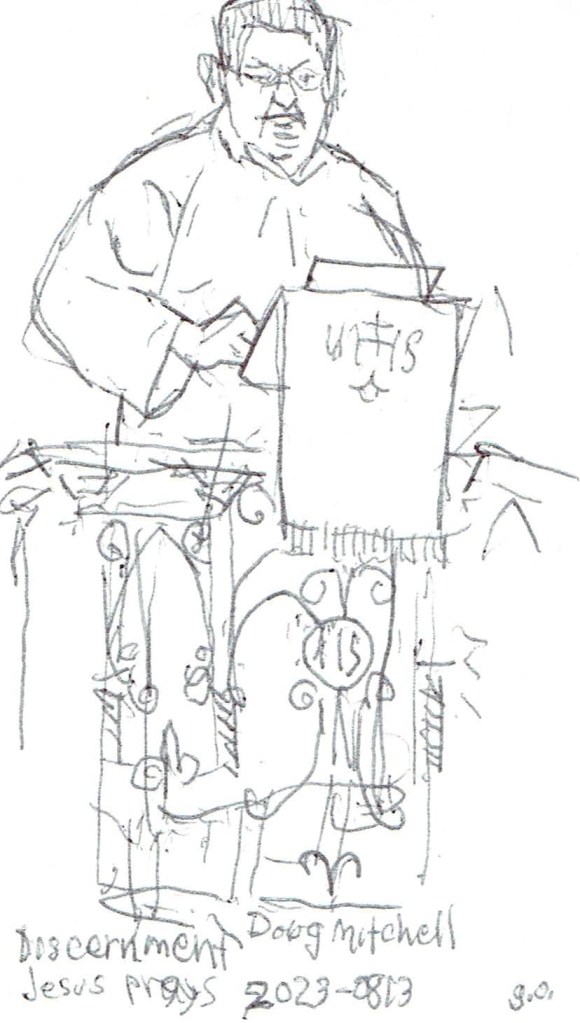
Several years ago, I was assigned to preach from these same lessons we have today, Proper 14 year A, in the season of Pentecost. I had just started preaching at Saint Martin’s in Des Plaines, IL. For several days, I studied these lessons and struggled about what I should preach. Then a realization came to me that at least two of the lessons were all about prayer and being in communion with the Holy Spirit. Our New Testament lessons, present to us, examples of prayer and discernment with the Spirit of God; from several different points of view.
The most obvious example of prayer and discernment is from our Gospel lesson from Matthew. A typical day in Jesus’ ministry on earth. After a long day of preaching and teaching, Jesus sends the people and his disciples away and secludes himself to pray. What could be a more typical passage in any of the Gospels? But notice how long Jesus is praying in this passage – He prays through most of the night into the early morning. My impression is that Jesus often prayed into the early hours of the morning. It was probably the only time of day when he could be alone, when it was quiet. In that time of profound silence and stillness when Nature herself seems to be holding her breath, (pause) that Jesus could pause to reflect and to allow His Father the time and space to speak to him.
Jesus Himself shows us how important it is to have this time for prayer and by His example.
It is in this profound silence, when we are calm, when we have emptied our minds of our concerns and our worries, when our thoughts are quiet; that we may be able to hear the Spirit of God speaking to us.
When I pray, I am reminded of the next passage in our gospel lesson.
We read that after Jesus had finished his prayer, he walks across the water through a violent storm to where the disciples were struggling to keep their ship afloat. The disciples see Jesus out in the storm, walking on the water – they hear him over the sound of the storm – and the disciples are terrified. They believe they are seeing and hearing some sort of ghost across the water. Peter asks Jesus to command him to walk across the water, and Jesus calls to Peter to join him.
This passage about Peter crossing the water feels like many of my experiences with prayer. How often have I started to pray, to attempt to reach across that gulf that separates us from God – only to start to sink, to be distracted by
the violent storm that sometimes is the world around me,
the violent storm that sometimes is my own thoughts and fears,
and finally, as I am going under, I call out to be saved:
O God, make speed to save me!
O Lord, make haste to help me!
Lord Jesus Christ, have mercy upon me! (pause)
For at least, 15 centuries, Christians have prayed these three, simple, prayers to our Lord: to be saved, to be helped, and for Jesus Christ to show us His mercy.
From all that I have read, and all I have experienced, I believe that people have always had these problems in prayer.
That is why we all must continually practice prayer, and through trial and error find out what works best for each one of us, at every stage of our lives; to help us in listening to the Holy Spirit.
In the discussion of prayer up to this point – we have concentrated on that journey of faith that we travel alone, in our personal relationship with the living God.
Paul, in our reading from Romans, takes this discussion to the next level.
But how are they to call on one in whom they have not believed?
And how are they to believe in one of whom they have never heard?
And how are they to hear without someone to proclaim him?
And how are they to proclaim him unless they are sent?
John Gill, the first Baptist theologian, in his commentary on Romans 10 verse 15 really helped me to understand the meaning of this passage.
Ordinary mission is of [people] to be pastors and teachers …. for whom Christ sends forth into such service, he bestows gifts on them, fitting them for it …. and it also includes a call unto it, which is …. by the Spirit of God ….. and the inclination of the heart to this good work which he forms; and which arises not from a vanity of mind, and a desire of popular applause, ….. but from a real concern for the good of souls, ….. being willing to deny themselves, and forsake all for Christ.
Paul’s four questions in our reading from Romans, are about how we are to call and select our ministers: our leaders and teachers in the community of Christ. Paul is laying the organizational groundwork for growing Christianity from a small group of believers to an organization – a Church. Paul is also describing the process of discernment; asking how we should listen; and to discern, to hear and to interpret, that whisper of the Holy Spirit, when we are being called to ministry into that larger Church organization.
Nine years ago, when I first preached on these lessons, I was two years into a discernment into ministry with the Episcopal Church in the Diocese of Chicago. I had met with my discernment committee at St. Martin’s in Des Plaines, IL over a period of six months. We had prayed together, and talked and listened together. My committee and I had discerned a call for me to continue to work towards ordination as a Deacon in the Episcopal Church.
As in our lesson from Genesis, with Joseph being sold into slavery by his own brothers, life seldom turns out the way we think it will. Joeseph had been the heir of his father’s fortune, the golden child, and not only that, but he was also having prophetic dreams in which his older brothers bowed down to him.
In my discernment for ministry in our church, life intervened in my plans in a much more gentle way than Joseph being sold to some passing Midianites. When I interviewed with the Diocese of Chicago committee on ministry about entering the Deacon training program, the committee did not hear my call to ministry. I was asked to come interview with them again – perhaps the following year. I had invested a great deal of my time and effort into entering the Deacon program in Chicago, and I was deeply disappointed. As I considered what I should do next, I answered another call for service, my father was losing his short-term memory and my mother needed help to take care of him. Darlene and I moved down here from Chicago to be near my parents as they made the transition from living in their own home to an independent living community in Marietta, Ohio.
I still have a great deal to learn about discernment.
What I have learned is that being in discernment is not an easy way to live, but it can be a very rewarding way to live.
Discernment guides us in choosing between the many paths we may follow, the many things we may do.
Usually, all the paths we are considering are good, productive, things that we can do with our time and our talents. But finding that one thing, that will really make a difference, can be difficult.
Discernment does not end after you are called into a ministry. Discernment continues.
My discernment continued even though I did not become a deacon in the Diocese of Chicago.
As I have come to understand what discernment is about, I was surprised by how familiar it turned out to be. It seems I have been in discernment all along, I was just not aware of what I was doing, as I used it in my daily life and work. All this time, in my work when I have been stuck on some technical problem. I clear my mind, and simply listen. (pause)
Given some time, from out of nowhere, I will receive an idea about how to approach that particular problem, or how to put together a solution. The artist waiting for inspiration, or the engineer awaiting that technical insight are in discernment. We are all opening ourselves; allowing our own divine nature to commune with the divine nature which is present in everything in the universe around us.
When we are inspired, we manage; for just that brief instant to hear God’s voice, the Spirit of God, speaking to us.
I have found that in discerning what God wants me to do – I am discovering what I am capable of becoming:
I am continually learning who I am.
God, as our Father and Creator, knows us far better that we know ourselves.
It is a startling, humbling and liberating experience to be middle aged and to be continually learning who I am, and what I am capable of becoming.
I’d like to leave you with this thought.
Discernment is for Everyone.
Not just those people, who are the clergy.
Not just those people who are on the vestry.
Not just those people, who are being called to ministry.
Everyone.
We should all be practicing how to be (pause) present and aware of the Holy Spirit speaking to us in our reflections, our thoughts, our feelings, and our prayers.
We should all be finding time, each day, to listen in profound silence, allowing the Spirit of God the time and space in our lives, so that we may hear (pause) the quiet voice of God.
Genesis 37:1-4, 12-28 Jacob settled in the land where his father had lived as an alien, the land of Canaan. This is the story of the family of Jacob.
Joseph, being seventeen years old, was shepherding the flock with his brothers; he was a helper to the sons of Bilhah and Zilpah, his father’s wives; and Joseph brought a bad report of them to their father. Now Israel loved Joseph more than any other of his children, because he was the son of his old age; and he had made him a long robe with sleeves. But when his brothers saw that their father loved him more than all his brothers, they hated him, and could not speak peaceably to him.
Now his brothers went to pasture their father’s flock near Shechem. And Israel said to Joseph, “Are not your brothers pasturing the flock at Shechem? Come, I will send you to them.” He answered, “Here I am.” So he said to him, “Go now, see if it is well with your brothers and with the flock; and bring word back to me.” So he sent him from the valley of Hebron.
He came to Shechem, and a man found him wandering in the fields; the man asked him, “What are you seeking?” “I am seeking my brothers,” he said; “tell me, please, where they are pasturing the flock.” The man said, “They have gone away, for I heard them say, ‘Let us go to Dothan.’” So Joseph went after his brothers, and found them at Dothan. They saw him from a distance, and before he came near to them, they conspired to kill him. They said to one another, “Here comes this dreamer. Come now, let us kill him and throw him into one of the pits; then we shall say that a wild animal has devoured him, and we shall see what will become of his dreams.” But when Reuben heard it, he delivered him out of their hands, saying, “Let us not take his life.” Reuben said to them, “Shed no blood; throw him into this pit here in the wilderness, but lay no hand on him” —that he might rescue him out of their hand and restore him to his father. So when Joseph came to his brothers, they stripped him of his robe, the long robe with sleeves that he wore; and they took him and threw him into a pit. The pit was empty; there was no water in it.
Then they sat down to eat; and looking up they saw a caravan of Ishmaelites coming from Gilead, with their camels carrying gum, balm, and resin, on their way to carry it down to Egypt. Then Judah said to his brothers, “What profit is it if we kill our brother and conceal his blood? Come, let us sell him to the Ishmaelites, and not lay our hands on him, for he is our brother, our own flesh.” And his brothers agreed. When some Midianite traders passed by, they drew Joseph up, lifting him out of the pit, and sold him to the Ishmaelites for twenty pieces of silver. And they took Joseph to Egypt.
Romans 10:5-15 Moses writes concerning the righteousness that comes from the law, that “the person who does these things will live by them.” But the righteousness that comes from faith says, “Do not say in your heart, ‘Who will ascend into heaven?’” (that is, to bring Christ down) “or ‘Who will descend into the abyss?’” (that is, to bring Christ up from the dead). But what does it say?
“The word is near you, on your lips and in your heart”
(that is, the word of faith that we proclaim); because if you confess with your lips that Jesus is Lord and believe in your heart that God raised him from the dead, you will be saved. For one believes with the heart and so is justified, and one confesses with the mouth and so is saved. The scripture says, “No one who believes in him will be put to shame.” For there is no distinction between Jew and Greek; the same Lord is Lord of all and is generous to all who call on him. For, “Everyone who calls on the name of the Lord shall be saved.”
But how are they to call on one in whom they have not believed? And how are they to believe in one of whom they have never heard? And how are they to hear without someone to proclaim him? And how are they to proclaim him unless they are sent? As it is written, “How beautiful are the feet of those who bring good news!”
Matthew 14:22-33 Jesus made the disciples get into the boat and go on ahead to the other side, while he dismissed the crowds. And after he had dismissed the crowds, he went up the mountain by himself to pray. When evening came, he was there alone, but by this time the boat, battered by the waves, was far from the land, for the wind was against them. And early in the morning he came walking toward them on the sea. But when the disciples saw him walking on the sea, they were terrified, saying, “It is a ghost!” And they cried out in fear. But immediately Jesus spoke to them and said, “Take heart, it is I; do not be afraid.”
Peter answered him, “Lord, if it is you, command me to come to you on the water.” He said, “Come.” So Peter got out of the boat, started walking on the water, and came toward Jesus. But when he noticed the strong wind, he became frightened, and beginning to sink, he cried out, “Lord, save me!” Jesus immediately reached out his hand and caught him, saying to him, “You of little faith, why did you doubt?” When they got into the boat, the wind ceased. And those in the boat worshiped him, saying, “Truly you are the Son of God.”
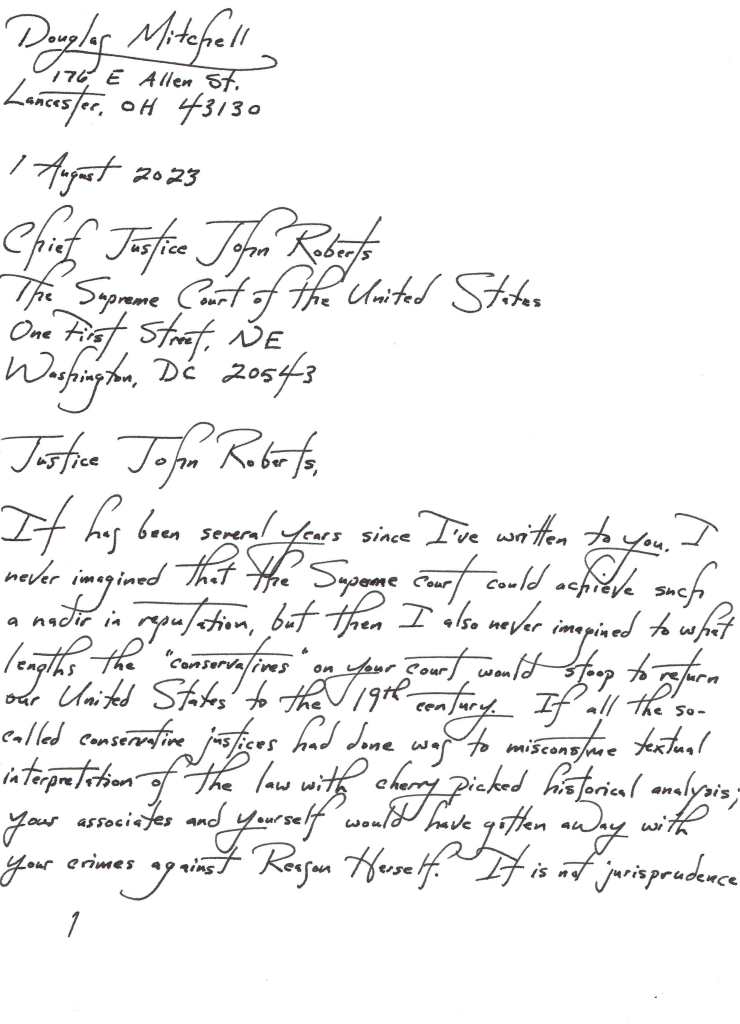
It has been several years since I’ve written to you. I had never imagined that the Supreme could achieve such a nadir in reputation, but then I also never imaged to what lengths the “conservative” justices of your court would stoop to return our United States to the 19thcentury. If all the so-called conservative justices had done was to misconstrue textual interpretation of the law with cherry picked historical analysis; your associates and yourself would have gotten away with your crimes against Reason Herself. It is not jurisprudence or Congress which protects our Republic and our People from your kind Sir, but your own corruption, greed, and arrogance that in the end will be your downfall.
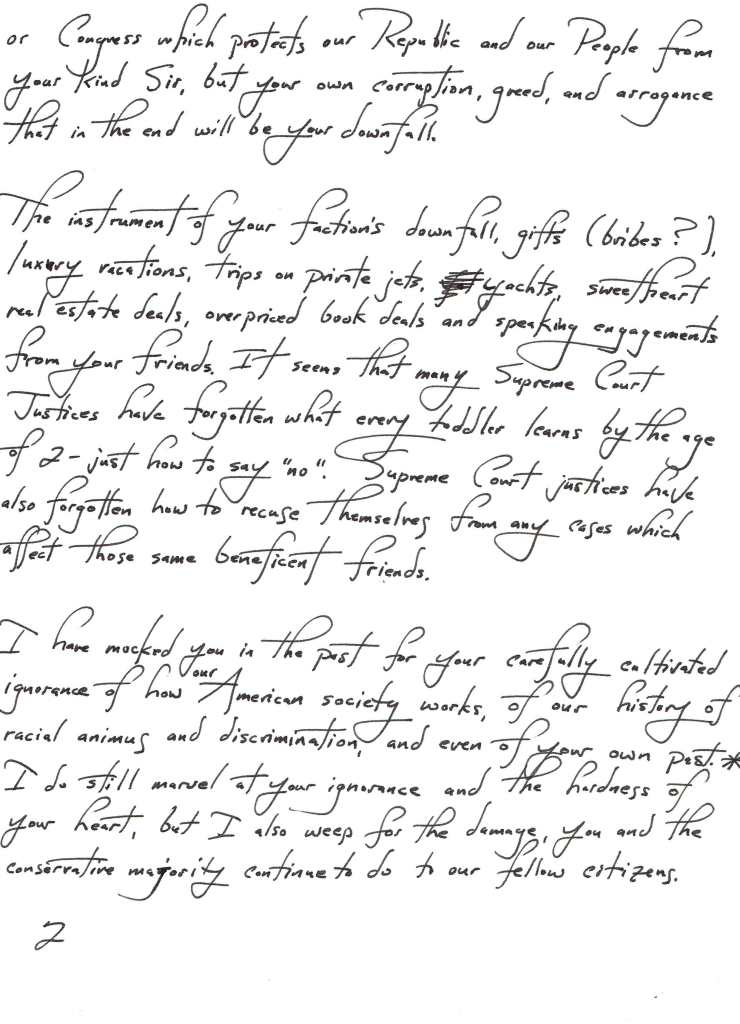
The instrument of your faction’s downfall, gifts (bribes?), luxury vacations, trips on private jets, yachts, sweetheart real estate deals, overpriced book deals and speaking engagements from your friends. It seems that many Supreme Court Justices have forgotten what every toddler learns by the age of two – just how to say “no”. Supreme Court justices who have also forgotten how to recuse themselves from any cases which affect those same beneficent friends.
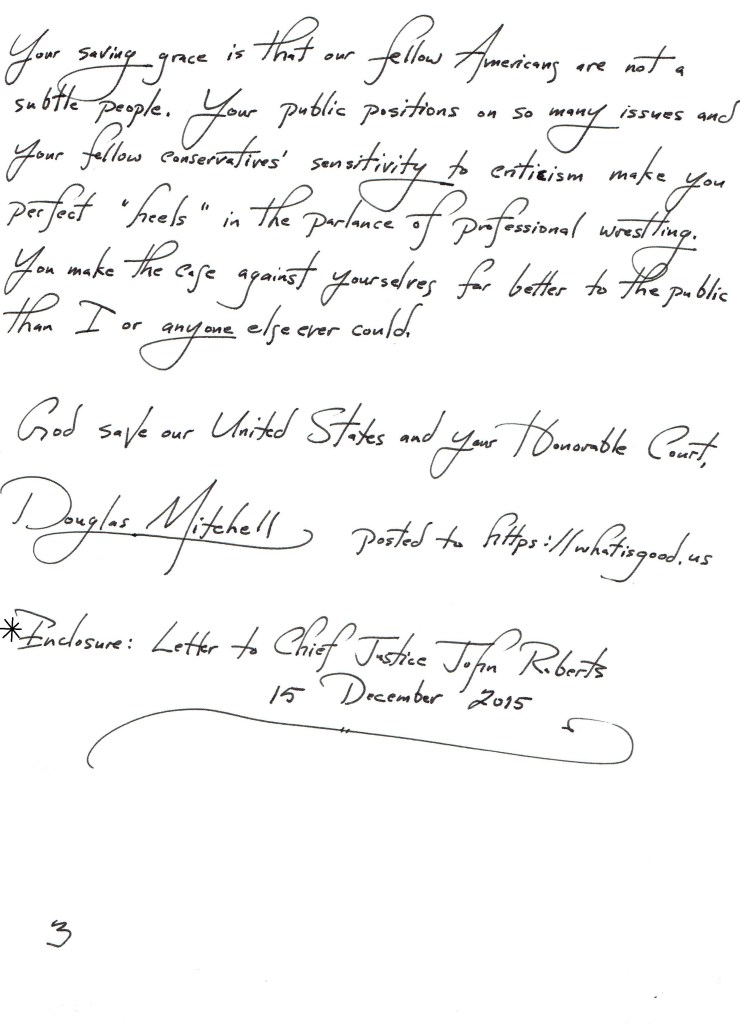
I have mocked you in the past for your carefully cultivated ignorance of how our American society works, of our history of racial animus and discrimination, and even of your own past*. I do still marvel at your ignorance and the hardness of your heart, but I also weep for damage, you and the conservative majority continue to do to our fellow citizens. Your saving grace is that our fellow Americans are not a subtle people. Your public positions on so many issues and your fellow conservatives’ sensitivity to criticism make you perfect “heels” in the parlance of professional wrestling. You make the case against yourselves much better to the public that I or anyone else ever could.
God save our United States and your Honorable Court,
Douglas Mitchell
*Attachment: Letter to Chief Justice John Roberts – December 15, 2015
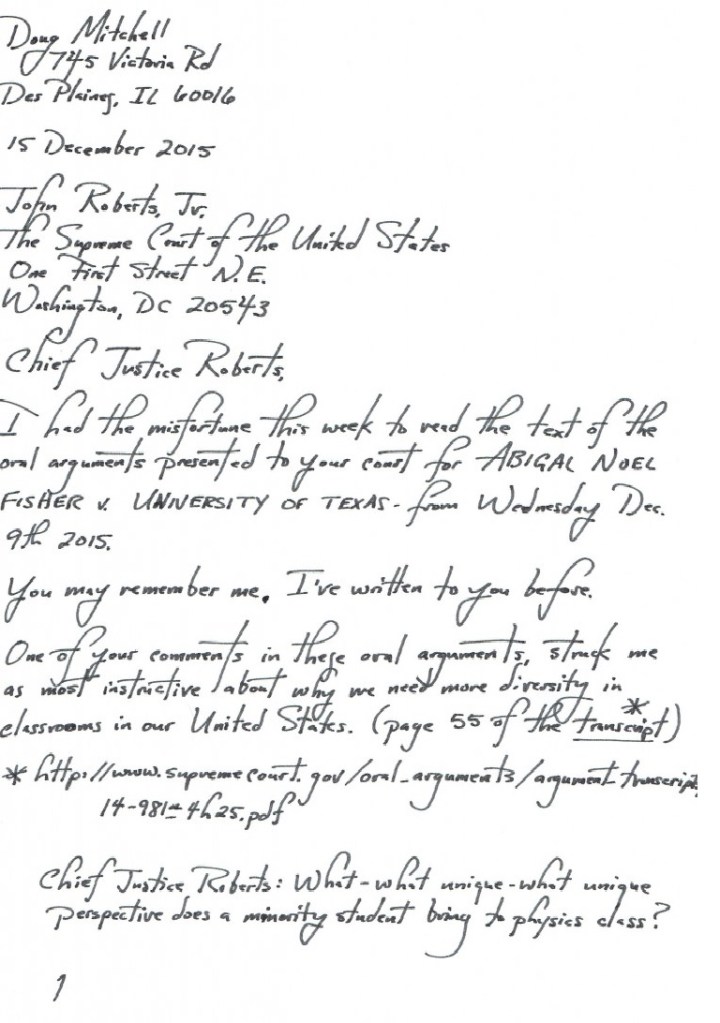
December 15, 2015
Chief Justice, John Roberts, Jr. The Supreme Court of the United States One First Street N.E. Washington, DC 20543
Chief Justice Roberts,
I had the misfortune this week to read the text of the oral arguments presented to your court for ABIGAIL NOEL FISHER, v. UNIVERSITY OF TEXAS – from Wednesday December 9th 2015. You may remember me. I’ve written to you before. One of your comments in these oral arguments, struck me as most instructive about why we need more diversity in classrooms in our United States. ( page 55 of the transcript. )
CHIEF JUSTICE ROBERTS: What — what unique — what unique perspective does a minority student bring to a physics class?
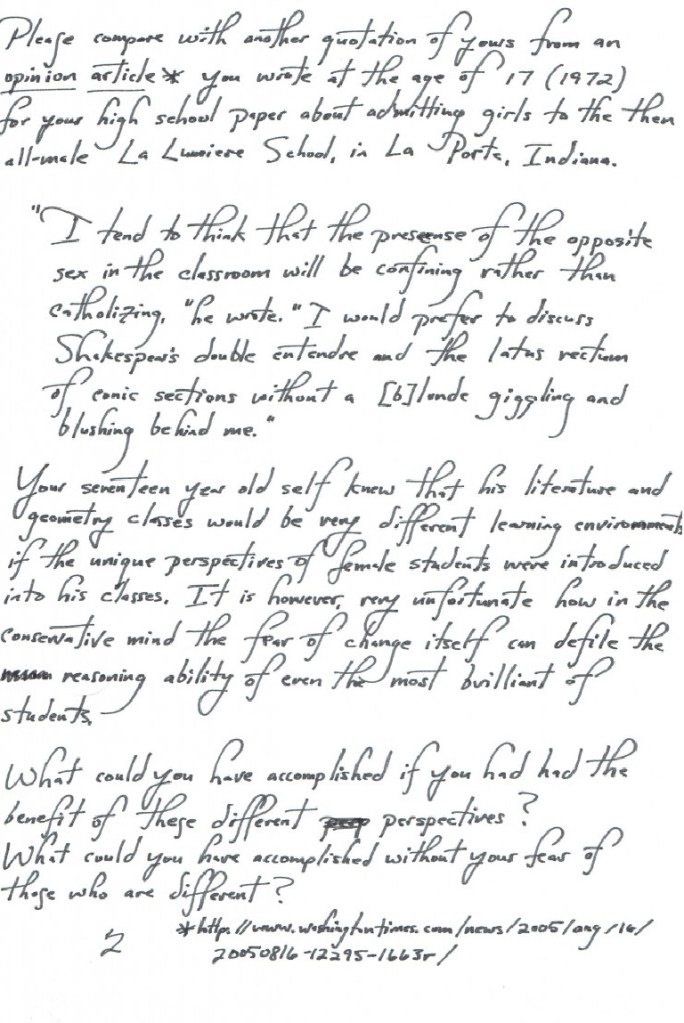
Please compare with another quotation of yours from an opinion article you wrote at the age of 17 (1972) for your high school paper about admitting girls to the then all-male La Lumiere School, in La Porte, Indiana.
I tend to think that the presence of the opposite sex in the classroom will be confining rather than catholicizing,” he wrote. “I would prefer to discuss Shakespeare’s double entendre and the latus rectum of conic sections without a [b]londe giggling and blushing behind me.
Your seventeen year old self knew that his literature and geometry classes would be very different learning environments if the unique perspectives of female students were introduced into his classes. It is however, very unfortunate how in the conservative mind the fear of change itself can defile the reasoning ability of even the most brilliant of students. What could you have accomplished if you had had the benefit of these different perspectives?
What could you have accomplished without your fear of those who are different?
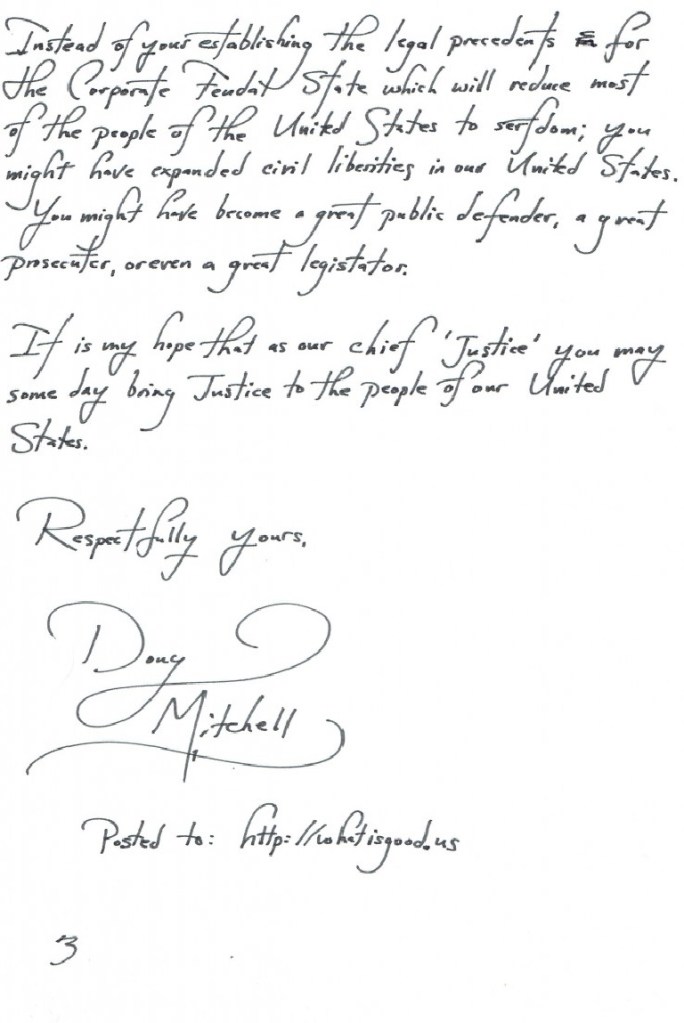
Instead of your establishing the legal precedents for the Corporate Feudal State which will reduce most of the people of the United States to serfdom; you might have expanded civil liberties in our United States. You might have become a great public defender, a great prosecutor, or even a great legislator.
It is my hope that as our chief ‘Justice’ you may some day bring justice to the people of our United States.
* The Axanar Combat Patrol and Klingon Hymn are essentially the same video with different soundtracks.
** Gathering Storm is a trailer, you will notice quick cuts from the other videos.
+ Star Trek Axanar opening scene is a great battle sequence – even in a not quite completely rendered state – it is the best Star Trek ship battle sequence I’ve ever seen.
A Personal Reflection on the Axanar Story Arc and Plot
I really like Axanar. I have followed it since the Prelude video was released 9 years ago. However, since that first Prelude video I have been troubled by one plot element that just does not ring true to my sense of the Klingon heart.
The basic concept behind Axanar – a history of the four year war with the Klingons, is that the Klingons did not view Star Fleet or the Federation as much of an enemy. There was little honor in slaughtering Federation ships and crews and so the Klingon fleet allowed some ships to get away; they did not press their advantage. The Klingons were content to secure the systems around the empire for future expansion and did not advance on into human space.
This allowed the Federation to pool the military technologies of all their member races: warp technology from the Vulcans, phasor technology from Andoria, and trained crews from all the Federation planets. The tide of the war turned. The Klingon Imperial navy was routed back to Klingon space with the new Ares class ships, and trained crews who had survived earlier encouters with the Klingons.
The Problem with Kharn
Kharn the Undying (in Prelude to Axanar ) gives this strange speech. OK, if the High Council had supported him he would have had the advanced ships he needed. Although, he squandered his advantage at the start of the war and he alone is to blame for that. Then Kharn talks about how frustrating it is to fight Star Fleet because the ships of the Federation are all crewed from different worlds, using differing tactics. This is totally out of character for a Klingon warrior. Any warrior is measured by the strength of his opponent. It is not in victory that a warrior is measured but in defeat. Fighting someone who is totally out of your class, against whom you have no chance of winning is the true test of the warrior. Death in battle against overwhelming odds is the ambition of every Klingon.
The Bridge Crew of the Ares
I served in the United States Navy. Although, I never served on the bridge of any ship, I maintained the electonic systems on the E2-C Hawkeye Aircraft (Carrier Air Early Warning – VAW 117). So the bridge scene during Interlude is not true to life in any military organization I’ve experienced. When an officer tells you to do something, you don’t make excuses. It does not matter how fast the Klingon ships are, commenting on it is not going to help you react any faster. Asking your captain to “give you a minute” just does not happen. It is a sad fact that so few actors have any military experience these days that these sorts of mistakes are pretty common. [In my opinion]The best war movies were the ones made right after WWII when so many men and women, including actors, had served in our military.
Getting off my soapbox, except for these small issues on my part – I love these Axanar videos. Axanar has captured the essence of what Star Trek was in the original series. That retro look of the uniforms. The sounds of the original star trek. And the ship designs, the Paramount designers are too into the Next Generation look of things, too sleek and streamlined. The Axanar team has truely captured what a precurser to Star Trek the original series would look like.
I congratulate you on your decision to not run again for the United States Senate. One less Republican senator will do much to improve the Senate. While it is quite impossible for you to redeem your party from the depths of depravity, senseless violence, racist and misogynistic hatred which it espouses; you could at least acknowledge that you are not as depraved, stupid, or frankly insane as your Republican colleagues by voting to impeach former President Trump for the crimes that he has so clearly committed.
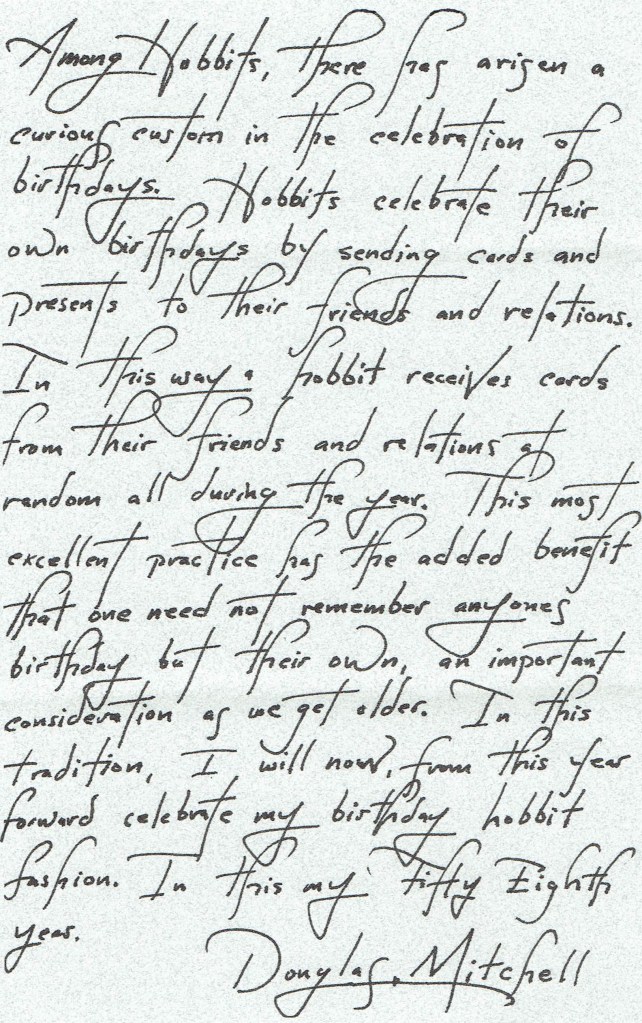
Among Hobbits, there has arisen a curious custom in the celebration of birthdays. Hobbits celebrate their own birthdays by sending cards and presents to their friends and relations. In this way a hobbit receives cards from their friends and relations at random all during the year. This most excellent practice has the added benefit that one need not remember anyones birthday but their own, an important consideration as we get older. In this tradition, I will now, from this year forward celebrate my birthday hobbit fashion. In this my Fifty Eighth year.
According to the scriptures, we are created in the image of God the Father, the Creator of the heavens and the earth.
I believe that the dreamers, makers and shapers most fully embrace this image of our Creator. We worship through our own acts of creation, with all the strength of our minds, our hearts, and our hands.
My father John William Mitchell was such a man. He loved repairing heavy equipment long abandoned by others. He delighted in using the backhoes, bulldozers and cranes which he had repaired and restored; like a small child playing with these machines in a sandbox. He and my mother Carol shared the dream of many homes, from the sweat of their brows and the work of their hands, they realized those dreams so that we could all enjoy and be sheltered by them.
My father was a man whose personal philosophy was physically demonstrated in wood, in steel and wire, electrical power and hydraulic movement, in homes which were comfortable in the cold of winter and the heat of summer. Like the true Buddhist, he did not covet the works of his hands, once he had repaired and used something he sold it to others, to fund the purchase of the next toy, or that next project. He only kept for himself the dream realized and the knowledge and skills he gained, which he then applied to the realization of that next dream.
Our father, mine and Susan’s, was first and foremost in everything he did; completely and authentically himself. As in the way of the Dao, he was like water, naturally taking on the shape of the situations in which he found himself, and also like water changing everything and everyone around him as a river moves sand from one bank to another. He raised us to always be who we are, to be true to ourselves. It did not matter to him who we decided to be, or how we lived our lives; but he always encouraged us to be wholehearted in whatever we do. If there was ever something we heard repeatedly from him as we were growing up, it was to never do anything half-assed.
In these last few years, my father showed us how to live day by day. With a grace that I have no words to express, he accepted the limitations of his mind and body.
I am grateful for every moment I shared in his presence.
He lives still in my heart and mind, and I will honor him with the work of my hands as long as I live.