
I had the privilege of giving the sermon at my church yesterday.
(Readings are below)
Hear the sermon here.
Several years ago, I was assigned to preach from these same lessons we have today, Proper 14 year A, in the season of Pentecost. I had just started preaching at Saint Martin’s in Des Plaines, IL. For several days, I studied these lessons and struggled about what I should preach. Then a realization came to me that at least two of the lessons were all about prayer and being in communion with the Holy Spirit. Our New Testament lessons, present to us, examples of prayer and discernment with the Spirit of God; from several different points of view.
The most obvious example of prayer and discernment is from our Gospel lesson from Matthew. A typical day in Jesus’ ministry on earth. After a long day of preaching and teaching, Jesus sends the people and his disciples away and secludes himself to pray. What could be a more typical passage in any of the Gospels? But notice how long Jesus is praying in this passage – He prays through most of the night into the early morning. My impression is that Jesus often prayed into the early hours of the morning. It was probably the only time of day when he could be alone, when it was quiet. In that time of profound silence and stillness when Nature herself seems to be holding her breath, (pause) that Jesus could pause to reflect and to allow His Father the time and space to speak to him.
Jesus Himself shows us how important it is to have this time for prayer and by His example.
It is in this profound silence, when we are calm, when we have emptied our minds of our concerns and our worries, when our thoughts are quiet; that we may be able to hear the Spirit of God speaking to us.
When I pray, I am reminded of the next passage in our gospel lesson.
We read that after Jesus had finished his prayer, he walks across the water through a violent storm to where the disciples were struggling to keep their ship afloat. The disciples see Jesus out in the storm, walking on the water – they hear him over the sound of the storm – and the disciples are terrified. They believe they are seeing and hearing some sort of ghost across the water. Peter asks Jesus to command him to walk across the water, and Jesus calls to Peter to join him.
This passage about Peter crossing the water feels like many of my experiences with prayer. How often have I started to pray, to attempt to reach across that gulf that separates us from God – only to start to sink, to be distracted by
the violent storm that sometimes is the world around me,
the violent storm that sometimes is my own thoughts and fears,
and finally, as I am going under, I call out to be saved:
O God, make speed to save me!
O Lord, make haste to help me!
Lord Jesus Christ, have mercy upon me! (pause)
For at least, 15 centuries, Christians have prayed these three, simple, prayers to our Lord: to be saved, to be helped, and for Jesus Christ to show us His mercy.
From all that I have read, and all I have experienced, I believe that people have always had these problems in prayer.
That is why we all must continually practice prayer, and through trial and error find out what works best for each one of us, at every stage of our lives; to help us in listening to the Holy Spirit.
In the discussion of prayer up to this point – we have concentrated on that journey of faith that we travel alone, in our personal relationship with the living God.
Paul, in our reading from Romans, takes this discussion to the next level.
But how are they to call on one in whom they have not believed?
And how are they to believe in one of whom they have never heard?
And how are they to hear without someone to proclaim him?
And how are they to proclaim him unless they are sent?
John Gill, the first Baptist theologian, in his commentary on Romans 10 verse 15 really helped me to understand the meaning of this passage.
Ordinary mission is of [people] to be pastors and teachers …. for whom Christ sends forth into such service, he bestows gifts on them, fitting them for it …. and it also includes a call unto it, which is …. by the Spirit of God ….. and the inclination of the heart to this good work which he forms; and which arises not from a vanity of mind, and a desire of popular applause, ….. but from a real concern for the good of souls, ….. being willing to deny themselves, and forsake all for Christ.
Paul’s four questions in our reading from Romans, are about how we are to call and select our ministers: our leaders and teachers in the community of Christ. Paul is laying the organizational groundwork for growing Christianity from a small group of believers to an organization – a Church. Paul is also describing the process of discernment; asking how we should listen; and to discern, to hear and to interpret, that whisper of the Holy Spirit, when we are being called to ministry into that larger Church organization.
Nine years ago, when I first preached on these lessons, I was two years into a discernment into ministry with the Episcopal Church in the Diocese of Chicago. I had met with my discernment committee at St. Martin’s in Des Plaines, IL over a period of six months. We had prayed together, and talked and listened together. My committee and I had discerned a call for me to continue to work towards ordination as a Deacon in the Episcopal Church.
As in our lesson from Genesis, with Joseph being sold into slavery by his own brothers, life seldom turns out the way we think it will. Joeseph had been the heir of his father’s fortune, the golden child, and not only that, but he was also having prophetic dreams in which his older brothers bowed down to him.
In my discernment for ministry in our church, life intervened in my plans in a much more gentle way than Joseph being sold to some passing Midianites. When I interviewed with the Diocese of Chicago committee on ministry about entering the Deacon training program, the committee did not hear my call to ministry. I was asked to come interview with them again – perhaps the following year. I had invested a great deal of my time and effort into entering the Deacon program in Chicago, and I was deeply disappointed. As I considered what I should do next, I answered another call for service, my father was losing his short-term memory and my mother needed help to take care of him. Darlene and I moved down here from Chicago to be near my parents as they made the transition from living in their own home to an independent living community in Marietta, Ohio.
I still have a great deal to learn about discernment.
What I have learned is that being in discernment is not an easy way to live, but it can be a very rewarding way to live.
Discernment guides us in choosing between the many paths we may follow, the many things we may do.
Usually, all the paths we are considering are good, productive, things that we can do with our time and our talents. But finding that one thing, that will really make a difference, can be difficult.
Discernment does not end after you are called into a ministry. Discernment continues.
My discernment continued even though I did not become a deacon in the Diocese of Chicago.
As I have come to understand what discernment is about, I was surprised by how familiar it turned out to be. It seems I have been in discernment all along, I was just not aware of what I was doing, as I used it in my daily life and work. All this time, in my work when I have been stuck on some technical problem. I clear my mind, and simply listen. (pause)
Given some time, from out of nowhere, I will receive an idea about how to approach that particular problem, or how to put together a solution. The artist waiting for inspiration, or the engineer awaiting that technical insight are in discernment. We are all opening ourselves; allowing our own divine nature to commune with the divine nature which is present in everything in the universe around us.
When we are inspired, we manage; for just that brief instant to hear God’s voice, the Spirit of God, speaking to us.
I have found that in discerning what God wants me to do – I am discovering what I am capable of becoming:
I am continually learning who I am.
God, as our Father and Creator, knows us far better that we know ourselves.
It is a startling, humbling and liberating experience to be middle aged and to be continually learning who I am, and what I am capable of becoming.
I’d like to leave you with this thought.
Discernment is for Everyone.
Not just those people, who are the clergy.
Not just those people who are on the vestry.
Not just those people, who are being called to ministry.
Everyone.
We should all be practicing how to be (pause) present and aware of the Holy Spirit speaking to us in our reflections, our thoughts, our feelings, and our prayers.
We should all be finding time, each day, to listen in profound silence, allowing the Spirit of God the time and space in our lives, so that we may hear (pause) the quiet voice of God.
Genesis 37:1-4, 12-28
Jacob settled in the land where his father had lived as an alien, the land of Canaan. This is the story of the family of Jacob.
Joseph, being seventeen years old, was shepherding the flock with his brothers; he was a helper to the sons of Bilhah and Zilpah, his father’s wives; and Joseph brought a bad report of them to their father. Now Israel loved Joseph more than any other of his children, because he was the son of his old age; and he had made him a long robe with sleeves. But when his brothers saw that their father loved him more than all his brothers, they hated him, and could not speak peaceably to him.
Now his brothers went to pasture their father’s flock near Shechem. And Israel said to Joseph, “Are not your brothers pasturing the flock at Shechem? Come, I will send you to them.” He answered, “Here I am.” So he said to him, “Go now, see if it is well with your brothers and with the flock; and bring word back to me.” So he sent him from the valley of Hebron.
He came to Shechem, and a man found him wandering in the fields; the man asked him, “What are you seeking?” “I am seeking my brothers,” he said; “tell me, please, where they are pasturing the flock.” The man said, “They have gone away, for I heard them say, ‘Let us go to Dothan.’” So Joseph went after his brothers, and found them at Dothan. They saw him from a distance, and before he came near to them, they conspired to kill him. They said to one another, “Here comes this dreamer. Come now, let us kill him and throw him into one of the pits; then we shall say that a wild animal has devoured him, and we shall see what will become of his dreams.” But when Reuben heard it, he delivered him out of their hands, saying, “Let us not take his life.” Reuben said to them, “Shed no blood; throw him into this pit here in the wilderness, but lay no hand on him” —that he might rescue him out of their hand and restore him to his father. So when Joseph came to his brothers, they stripped him of his robe, the long robe with sleeves that he wore; and they took him and threw him into a pit. The pit was empty; there was no water in it.
Then they sat down to eat; and looking up they saw a caravan of Ishmaelites coming from Gilead, with their camels carrying gum, balm, and resin, on their way to carry it down to Egypt. Then Judah said to his brothers, “What profit is it if we kill our brother and conceal his blood? Come, let us sell him to the Ishmaelites, and not lay our hands on him, for he is our brother, our own flesh.” And his brothers agreed. When some Midianite traders passed by, they drew Joseph up, lifting him out of the pit, and sold him to the Ishmaelites for twenty pieces of silver. And they took Joseph to Egypt.
Romans 10:5-15
Moses writes concerning the righteousness that comes from the law, that “the person who does these things will live by them.” But the righteousness that comes from faith says, “Do not say in your heart, ‘Who will ascend into heaven?’” (that is, to bring Christ down) “or ‘Who will descend into the abyss?’” (that is, to bring Christ up from the dead). But what does it say?
“The word is near you,
on your lips and in your heart”
(that is, the word of faith that we proclaim); because if you confess with your lips that Jesus is Lord and believe in your heart that God raised him from the dead, you will be saved. For one believes with the heart and so is justified, and one confesses with the mouth and so is saved. The scripture says, “No one who believes in him will be put to shame.” For there is no distinction between Jew and Greek; the same Lord is Lord of all and is generous to all who call on him. For, “Everyone who calls on the name of the Lord shall be saved.”
But how are they to call on one in whom they have not believed? And how are they to believe in one of whom they have never heard? And how are they to hear without someone to proclaim him? And how are they to proclaim him unless they are sent? As it is written, “How beautiful are the feet of those who bring good news!”
Matthew 14:22-33
Jesus made the disciples get into the boat and go on ahead to the other side, while he dismissed the crowds. And after he had dismissed the crowds, he went up the mountain by himself to pray. When evening came, he was there alone, but by this time the boat, battered by the waves, was far from the land, for the wind was against them. And early in the morning he came walking toward them on the sea. But when the disciples saw him walking on the sea, they were terrified, saying, “It is a ghost!” And they cried out in fear. But immediately Jesus spoke to them and said, “Take heart, it is I; do not be afraid.”
Peter answered him, “Lord, if it is you, command me to come to you on the water.” He said, “Come.” So Peter got out of the boat, started walking on the water, and came toward Jesus. But when he noticed the strong wind, he became frightened, and beginning to sink, he cried out, “Lord, save me!” Jesus immediately reached out his hand and caught him, saying to him, “You of little faith, why did you doubt?” When they got into the boat, the wind ceased. And those in the boat worshiped him, saying, “Truly you are the Son of God.”
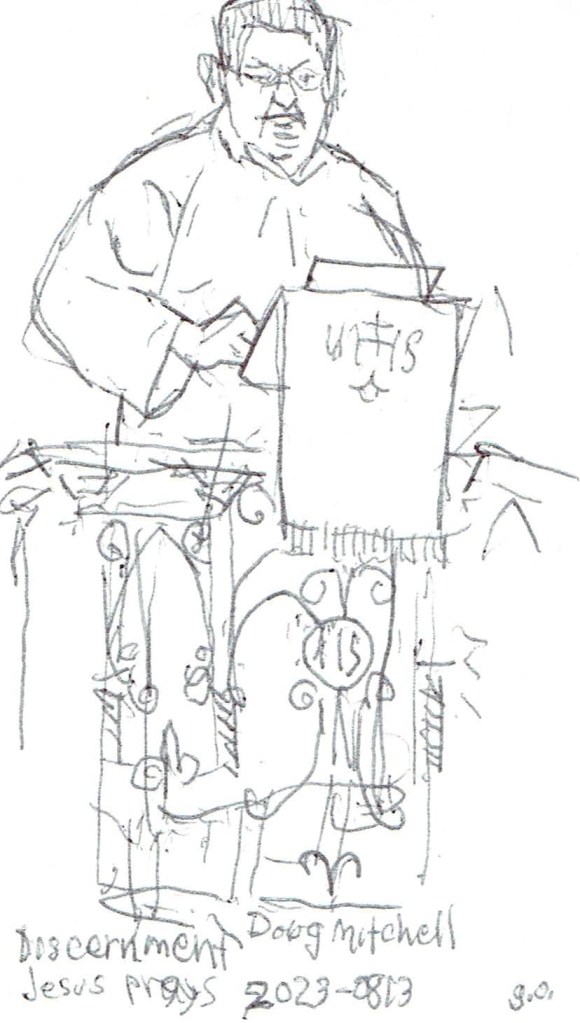
Sketch of me preaching – Gerald Owsley
 What is Good